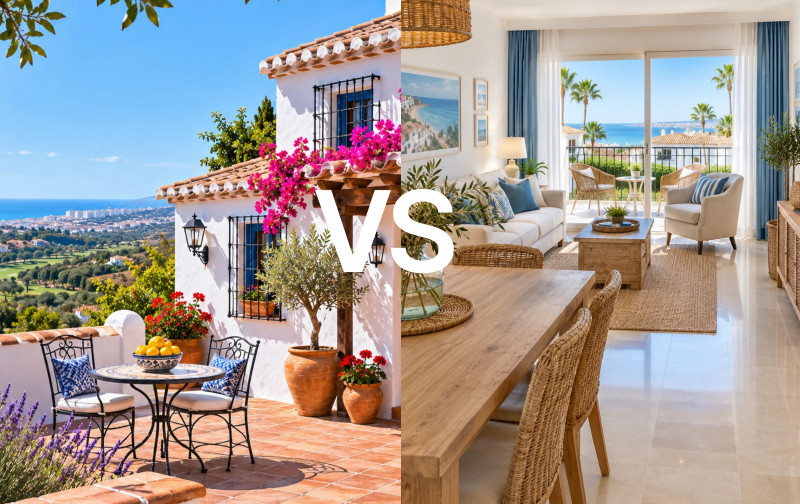
When most people picture a home on the Costa del Sol, they picture the coast: a terrace with a sea view, a short stroll to the beach, a promenade lined with chiringuitos. It's a lovely life, and I sell plenty of homes that deliver exactly that.
But over my nine years living here, I've watched more and more buyers turn their heads inland, towards the campo. These are the rolling hills, olive groves and quiet valleys that sit just behind the coastline, often only ten or fifteen minutes from the sea.
So which is right for you? Here's my honest take on country living versus coastal living, the good, the not-so-good, and why I think the campo deserves a much closer look than most people give it.
Why so many buyers are falling for the campo
Land, and lots of it. On the coast, a garden is a luxury. In the campo, plots of several thousand square metres are common, and some fincas come with a hectare or more. That's room for a vegetable patch, fruit trees, a few chickens, or simply a garden you can lose an afternoon in.
Space inside and out. Country homes tend to be built more generously, with bigger rooms, wider terraces and outbuildings. Your neighbours are a field away, not a wall away. Room for a pool, a casita for visiting family, a workshop or a home office with a view is the norm rather than the exception.
Peace and quiet, all year round. On the coast, July and August bring the crowds: full beaches, packed car parks, queues at every restaurant and a soundtrack of late-night parties. In the campo, summer sounds much like the rest of the year. Birdsong, cicadas and the odd goat bell. You can still head down to the beach when you fancy it, and then come home to calm.
Privacy. No overlooking balconies, no shared pool rotas, no community rules about where you hang your washing. Your home is yours to enjoy exactly as you like.
Views that stay views. Many campo homes sit on higher ground, with panoramic views over the hills and often down to the Mediterranean. Because building in rural areas is tightly controlled, there's far less risk of a new block going up in front of you.
More home for your money. Price per square metre, both built and plot, is generally lower inland than on the frontline. Your budget often stretches to a detached villa with land, where on the coast it might buy an apartment.
Cleaner air and starrier nights. Less traffic and less light pollution make a real difference. On a clear night, the stars out here are something else.
A healthier, outdoor life. Walking and cycling routes start from your front gate, and riding stables, hiking trails and golf courses are rarely far away. Gardening, dining al fresco and long lunches on the terrace become the rhythm of the week.
Room for animals. Dogs with space to run, horses, rescue cats. The campo is a very good place to be a pet owner.
A taste of the real Andalucía. Local ventas serving hearty food at honest prices, village fiestas, Spanish neighbours who will happily share their lemons. The campo connects you to a side of Spanish life that the coastal strip can hide.
Lower running costs in places. With no apartment community fees and, increasingly, solar panels on the roof, some campo homeowners find their monthly costs lower than they expected. Many homes are well suited to solar, with plenty of roof and ground space and long hours of sunshine.
The honest trade-offs
I'd be doing you a disservice if I painted the campo as perfect. Here's what to weigh up before you fall in love with a view.
You'll need a car, probably two. Very few campo homes are within walking distance of a shop, a bus stop or a school. Every errand is a drive, and if there are two of you with different schedules, a second car soon stops being optional.
Services can be different. Not every rural property is on mains water or mains drainage. Some rely on a well or water delivery, and many use a septic tank. Bottled gas is common, and fibre broadband, while far more widespread than it was, isn't guaranteed everywhere. These things all work perfectly well, but you need to know what you're buying.
More land means more upkeep. Gardens, pools, fences and long driveways all need looking after. Many owners hire a gardener, especially to clear dry vegetation before summer, which is an important fire-safety task in rural areas.
Deliveries and post can be hit and miss. Some campo addresses don't receive post to the door, so a PO box in town is common. Couriers sometimes need a phone call and a pin drop to find you.
Social life takes a little more effort. You won't bump into friends on the promenade. Nights out mean someone stays sober or you book a taxi, and taxis to the campo can take a while.
Legal checks matter even more. Rural properties need careful due diligence on licences, extensions and land classification. Some older homes have additions that were never fully legalised. A good independent lawyer is essential, and it's one of the reasons I always work closely with trusted local solicitors on campo sales.
Resale can take longer. The pool of buyers for a rural villa is smaller than for a coastal apartment. A well-presented, fully legal campo home in a sought-after area still sells, but it's usually a longer-term purchase.
So, what are the roads really like?
This is the question I'm asked most, and the honest answer is: it depends on the road.
The main routes into the hills are generally well surfaced and well maintained. Where things vary is the last stretch, the camino that leads from the main road to your gate. Some are smoothly tarmacked. Others are concrete, a little narrow and steep in places. A few are still dirt tracks.
A few things are worth knowing:
Many access roads are narrow and winding. You'll get used to pulling into a passing place to let a neighbour by, usually with a friendly wave.
Rain can take its toll. After heavy winter storms, unsealed tracks can rut or wash out, and potholes appear. Most dry out quickly, but it's worth seeing a road after rain if you can.
Who maintains it? Some caminos are looked after by the town hall. Others are private and shared between neighbours, who split the cost of repairs. Always ask which applies before you buy.
Your car matters. You don't need a 4x4 for most campo homes, but a car with decent ground clearance makes life easier on rougher tracks.
Time it, don't map it. A home that looks 5 km from the beach on a map might take 15 minutes to reach, or 8. I always suggest driving the route at the times you'd use it, the school run, the supermarket trip, the drive home after dinner.
Once you know the road, it simply becomes part of the journey home. Most of my campo clients tell me that winding up through the hills at the end of the day is one of the best bits.
Finding the best of both
For me, the trade-off tips firmly in the campo's favour, as long as you choose the right location. The sweet spot is the countryside just behind the coast: close enough to pop down for lunch by the sea, far enough to leave the summer crowds behind.
And I'm not just saying that as an estate agent. I live in the campo myself, so I know first hand what it's like, winding roads and all, and I honestly wouldn't have it any other way. Our four dogs would certainly agree. They have room to run, fields to explore and no neighbour's balcony to bark at. For a household of furry friends, there really is nowhere better.
The good news is that much of the Costa del Sol has a campo like this on its doorstep. The hills above Mijas, Fuengirola, Marbella and Estepona are dotted with fincas and country villas, many with views down to the Mediterranean. Plenty of them sit just 10 to 20 minutes from a beach, a supermarket and a golf course, and the motorway puts Málaga Airport within easy reach of much of it.
It's country living without feeling cut off. You can spend the morning in the garden, have lunch by the sea and be home in time for sunset on the terrace. In August, when the coast is at its busiest, you get to enjoy the best of it and then retreat to your own peaceful corner of the hills.
Two campo homes I'd love to show you
If this way of life appeals, I have two country homes on my books right now that offer unique perspectives - one just outside La Cala de Mijas and one on the edge of Mijas Golf - that show exactly what the campo can offer.
Renovated 5 Bed Family Villa, La Cala de Mijas – €1,450,000
Tucked into the countryside of La Majadilla del Muerto, just above La Cala de Mijas, this beautifully renovated villa offers 425 m² of living space on a 4,756 m² plot. It was designed by the family, for the family. The main level is largely one-level living, with three bedrooms, a master suite with an impressive ensuite, wooden beam ceilings, and a kitchen built around a big family island. Downstairs, a lower level with its own garden entrance adds two more bedrooms, a second kitchen and a lounge, ideal for multi-generational living or visiting family.
Outside is where it really comes into its own. There's a swimming pool, one of the most impressive outdoor kitchens you'll come across, vegetable gardens, a flat lawn for the children and an electric gated entrance, all surrounded by olive and fruit trees. Shops, restaurants and everyday amenities are a 10-minute drive away, the beaches of La Cala are within easy reach, golf is close by, and Málaga Airport is around 30 minutes away. View the full listing
Sea View Villa with Guest Apartment, Mijas Golf – €825,000
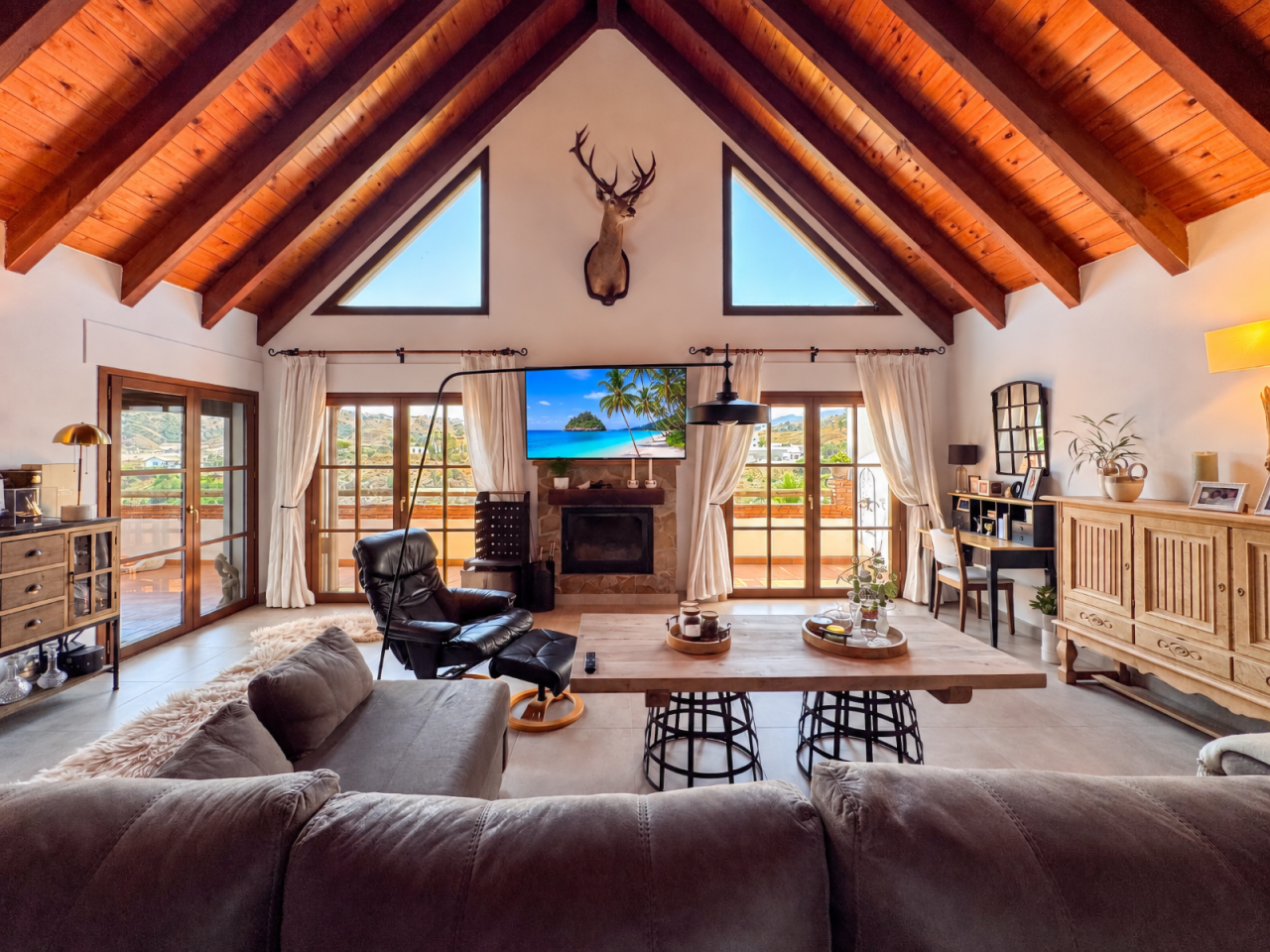
On the edge of Mijas Golf, this detached three-bedroom villa sits on a 6,434 m² private plot with sea and mountain views stretching from Fuengirola across to Mijas Pueblo. The main house is all on one level, with 318 m² of living space, two master suites, a lounge with wooden-beamed ceilings and a fireplace, and a spectacular indoor terrace for family gatherings in any weather. A self-contained guest apartment with its own kitchen, bathroom and terrace is perfect for visitors.
The 234 m² of terraces wrap around a recently refurbished pool, framed by orange, lime, mango, avocado and olive trees with irrigation already in place. Solar panels, electric gates, plenty of parking and a certificate of non-infraction complete the picture. The Los Lagos and Los Olivos golf courses, supermarkets and restaurants are minutes away. Fuengirola's beaches and marina are around 10 minutes by car, La Cala's beach around 15, and Málaga Airport around 25. View the full listing
Come and see the campo for yourself
The best way to know whether country life is for you is to experience it. I'd be delighted to show you either of these homes, drive the roads with you and share what I've learned from living in the campo myself.
Introduction: Your Spanish Dream - Navigating the Post-Brexit Reality in 2025!
Thinking of making the sun-drenched move from the UK to Spain in 2025? Fantastic! Spain offers a vibrant culture, stunning landscapes, and an incredible lifestyle. But let's be honest, the idea of "visa, customs, and bureaucracy" can feel like a labyrinth, especially post-Brexit....
In the heart of Mijas Golf, surrounded by the rolling hills of the Costa del Sol, lies a hotel that redefines luxury and relaxation—La Zambra Hotel & Spa. Once known as the iconic Byblos hotel, a favorite in the 80s and 90s, this remarkable retreat has been completely transformed. Today, it blends the timeless charm of Andalusian architecture with...
We’re excited to announce that Alison Norton Properties will be attending A Place in the Sun Live at the London ExCel from 9th to 11th May 2025!This is the UK’s leading overseas property exhibition—and if you’ve been dreaming about owning a home under the Spanish sun, this is the perfect opportunity to take the next step.
Why Visit O...
Thinking of Relocating to Mijas Golf? Here's What You Need to Know
Thinking about moving to Mijas Golf? You’re not alone! This tranquil residential community in Mijas Costa has become a magnet for British retirees, European expats, and golf enthusiasts alike, and it is easy to see why. From world-class golf courses and spectacular mountain views to it...