


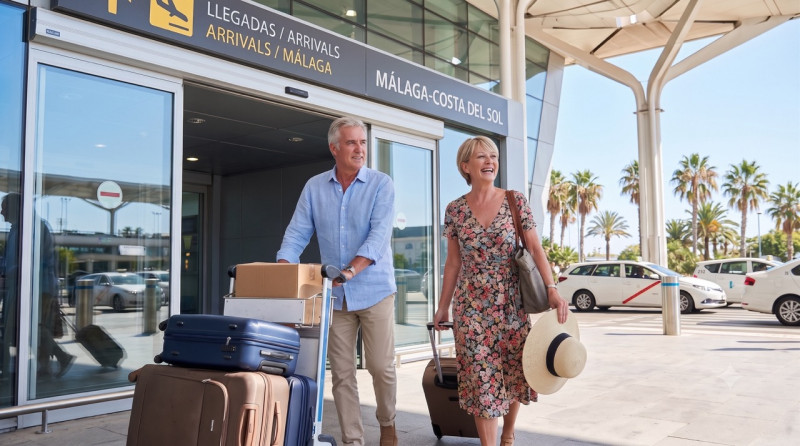
People ask me this question more than almost any other. And every time, I find myself smiling — because the answer isn't one thing. It's everything, all at once.
I made the move to the Costa del Sol nine years ago, relocating my family from South Africa. Like most people who arrive here, I came with a mix of excitement and nerves. What I didn't expect was just how quickly this stretch of southern Spain would feel like home — or how completely it would change the way I think about quality of life. Now, as an estate agent helping others make that same move, I see it happen time and again. People arrive hesitant and leave — or rather, stay — transformed.
So, why do people relocate to the Costa del Sol? Let me walk you through the reasons I hear most often, and the ones I've lived myself.
1. The Weather — And What It Does to You
Let's start with the obvious, because it really does matter. The Costa del Sol takes its name seriously. This region enjoys more than 300 days of sunshine per year, with mild winters rarely dipping below 12–15°C and long, warm summers that stretch well into October. It is, quite simply, one of the most reliably pleasant climates in Europe.
But beyond the statistics, what people rarely anticipate is the psychological effect. When you wake up to blue skies most mornings, when you can eat outside in January, when winter means a light jacket rather than months of grey — life changes. You move more, you socialise more, and you feel better. Many of my clients tell me it has made a profound difference to their mental and physical wellbeing, particularly those coming from the UK, Ireland, or northern Europe.
2. Location — Europe's Most Connected Sunshine Coast
The Costa del Sol runs along the southern coast of Andalusia, stretching roughly from Nerja in the east to Manilva in the west — with Málaga at its heart. And Málaga Airport is one of the great unsung advantages of this region.
With direct flights to over 60 countries and close links to most major European cities — many under three hours away — you are never truly far from home. This matters enormously for those maintaining business interests elsewhere, for families with ties across Europe, or simply for people who want the lifestyle without the isolation. The motorway network along the coast (the A-7 and AP-7) is well-maintained and connects the major towns efficiently. Málaga itself has a high-speed rail link to Madrid, making the capital easily accessible.
You get the sunshine and the pace of southern Spain, without giving up connectivity.
3. A Stable, Established Expat Community
The Costa del Sol has been welcoming international residents for over 60 years. That long history has created something genuinely valuable: a mature, multi-national community with deep roots, real infrastructure, and a collective understanding of what it means to build a life here as a foreigner.
English-speaking schools, international medical centres, bilingual legal and financial services, established social networks, sports clubs, and community associations — all of these exist here in a way they simply don't in newer or more off-the-beaten-track destinations. Whether you're arriving with children, approaching retirement, or moving to work remotely, you will find your people and your footing faster than you might expect.
4. Healthcare — Better Than You Might Think
Spain's public healthcare system is consistently ranked among the best in Europe, and the Costa del Sol benefits from a strong network of both public hospitals and private clinics. Málaga's Hospital Regional Universitario is a major teaching hospital, and private facilities such as Hospital Quirónsalud Marbella and HC Marbella offer international-standard care with English-speaking staff.
Many expat residents use a combination: the public system for routine care (accessible via registration on the padrón and, for EU residents or those with the S1 form, at no cost), and private health insurance for faster access to specialists. Comprehensive private cover in Spain is, in most cases, significantly more affordable than equivalent cover in the UK or elsewhere in northern Europe.
5. Real Estate — An Investment That Works on Multiple Levels
The Costa del Sol property market is one of the most robust in Spain — and one of the most resilient in Europe. It has consistently attracted international buyers across economic cycles, underpinned by sustained demand, a limited supply of quality coastal property, and a steady stream of both lifestyle buyers and investors.
For those buying to live, property prices remain competitive when measured against comparable coastal destinations in France, Portugal, or Italy. For those buying to invest, the rental market on the Costa del Sol is strong. The region attracts millions of visitors annually, and long-term rental demand from newly arrived residents and digital nomads has grown significantly in recent years.
Whether you're looking for a lock-up-and-leave apartment in a golf community, a family villa with a garden, or an investment property with rental potential — the Costa del Sol offers a range that few markets can match.
And if your new property needs work? That's something we can help with too. Through our in-house partnership with Norton & Daughters, led by James Norton — who has been building and developing properties here for over 20 years — we offer a complete renovation service, from kitchen and bathroom updates to full villa rebuilds. It means you can buy the home with potential, not just the one that's already perfect.
6. Cost of Living — Comfortable, Not Cheap
I want to be straightforward here: the Costa del Sol is not the cheapest place in Spain. Marbella, Benahavís, and the Golden Mile command prices that reflect their desirability. But when you compare the overall cost of living to equivalent lifestyle destinations in the UK or northern Europe, most people are pleasantly surprised.
Dining out is significantly more affordable — a quality three-course lunch with wine for under €15 is still very much a reality. Fresh produce from local markets is excellent value. Fuel, utilities (aided by Spain's solar potential and mild climate), and day-to-day services all tend to cost less than their UK equivalents. Factor in the quality of life, and the equation looks very different.
7. Political Stability and Legal Framework
Spain is a full EU member state with a well-established democratic system, an independent judiciary, and a clear legal framework for property ownership and residency. For non-EU nationals, post-Brexit residency routes exist via the Non-Lucrative Visa, the Digital Nomad Visa, and other established pathways. Property rights are well-protected in law — but it's worth noting that the property market itself is largely unregulated. There is no statutory requirement for estate agents to be licensed or professionally accredited, which makes choosing the right agent one of the most important decisions a buyer can make.
I always encourage buyers to work with a reputable, independent Spanish lawyer (not one recommended by the selling agent) and to carry out thorough due diligence. Done correctly, buying and living in Spain as a foreign national is a well-trodden path — but the quality of the people guiding you through it makes all the difference.
8. The Lifestyle — Hard to Quantify, Impossible to Overstate
Food, culture, outdoor living, golf, sailing, hiking in the Sierra de las Nieves national park, flamenco festivals, world-class restaurants — the Costa del Sol is not a one-note destination. It offers a richness of experience that rewards those who dig beyond the beach.
The pace of life here is different. Not slow — but human. People make time for each other. Meals are events, not just refuelling stops. The outdoors is part of daily life, not a weekend treat. And the blend of cultures — Spanish, British, Scandinavian, Middle Eastern, American — creates a cosmopolitan atmosphere that is genuinely stimulating.
After nine years, I still find myself discovering new villages, new restaurants, new corners of this coastline. That, perhaps more than anything, is what makes it home.
9. Where We Work — Mijas, Fuengirola & East Marbella
I'm based in La Cala Hills in Mijas, and the areas I know best — and focus on most — are Mijas municipality, Fuengirola, and the stretch of coastline running east towards Marbella. This is a part of the Costa del Sol that offers exceptional variety: established Spanish towns, beautiful beaches, golf communities, rural hillside settings, and some of the most attractive property values on the entire coast.
Mijas is one of the most diverse municipalities on the Costa del Sol, and one of the most rewarding to explore. It stretches from the famous whitewashed village of Mijas Pueblo perched in the hills, down through golf urbanisations such as Mijas Golf, La Cala Golf, and Calanova, and all the way to the coast at La Cala de Mijas — a genuinely lovely beach town with a real local character that has retained its charm without feeling underdeveloped. The golf communities in particular offer outstanding value: well-maintained apartments, townhouses, and villas set around courses designed by some of the game's great architects, with mountain and sea views and a peaceful, established feel. For buyers seeking space, Mijas also has a collection of country houses and cortijos set in the campo — olive groves, fruit trees, private pools — that represent something genuinely special.
Fuengirola punches well above its weight. It's often underestimated — seen as a busy resort town rather than a serious place to live — but residents know differently. The town has a long, well-kept promenade, excellent transport links (it sits on the Cercanías rail line connecting to Málaga city centre and the airport), a thriving international community, a large weekly market, and a wide range of amenities that make day-to-day life genuinely easy. Property here covers the full spectrum: compact studios and one-bedroom apartments ideal for investors or those seeking a foothold on the coast at an accessible price point, through to spacious frontline beach apartments and townhouses in the surrounding urbanisations. For first-time buyers or those looking to maximise rental yield, Fuengirola is consistently one of the strongest performers on this stretch of coast.
East Marbella — the area running from Calahonda through Riviera del Sol, Cabopino, and towards Elviria — offers a quieter, more residential character than central Marbella, while still giving access to everything that name implies. Calahonda is one of the coast's most established expat communities, with an enormous range of property types and price points. Cabopino has a beautiful marina and some of the most unspoilt natural dunes and beach on the Costa del Sol. Elviria is leafy, spacious, and popular with families. Property across this stretch runs from well-priced apartments in mature urbanisations — some offering remarkable value — to larger detached villas with mature gardens and generous plots, and luxury homes that hold their own against anything in the wider Marbella area.
Across all three areas, I work with buyers looking for every type of property: studios and one-bedroom apartments for investment or as a first step onto the coast; two and three-bedroom apartments in golf and beach communities; townhouses offering more space and often a private garden or roof terrace; detached villas ranging from holiday homes to substantial family residences; and country houses for those who want privacy, land, and a genuinely different pace of life. Whatever your budget and whatever your priorities, this stretch of coast almost certainly has something that fits.
10. But Let's Be Honest — There Are Pitfalls Too
I wouldn't be doing my job properly if I only told you the good parts. The Costa del Sol is a wonderful place to live — but moving to a foreign country is not without its complexity, and Spain has a few specific areas where people regularly come unstuck. Here's what I'd want anyone to know before they leap.
The buying process requires careful navigation — and careful choice of agent. This is something many buyers don't realise until they're already in the process: the Spanish property market is largely unregulated. Unlike the UK or Ireland, there is no statutory licensing body that all estate agents must register with, no mandatory professional qualifications, and no overarching regulatory framework governing who can and cannot sell property here. In practice, that means the quality, ethics, and competence of agents varies enormously — and choosing the wrong one carries real risk.
This is why accreditation and professional membership matter so much. I'm a member of LPA — Leading Property Agents of Spain — an association that holds its members to the highest professional standards in the industry. It's not a badge that's easy to obtain, and it's one I'm genuinely proud of, because it assures my clients that they're working with an agent who operates with integrity, transparency, and accountability.
Beyond the choice of agent, there are additional costs to budget for beyond the purchase price — typically 10–12% on top, covering ITP (transfer tax) or IVA on new builds, notary fees, land registry fees, and legal costs. There is no chain system as such, but there are reservation contracts, private purchase contracts, and completion at a notary — each stage carrying legal weight. Going in without an independent Spanish solicitor is, in my view, a serious risk. I always recommend buyers instruct their own lawyer, entirely separate from the selling agent or developer.
Taxes catch people off guard.
Spain taxes residents on their worldwide income — and the definition of tax residency (spending more than 183 days per year in the country) catches more people than you'd expect. Once you're resident, you're subject to Spanish income tax, wealth tax (in Andalusia this was re-introduced in modified form), and capital gains rules that differ from those in your home country. Non-residents who own property here also have obligations — an annual non-resident tax declaration is required even if you rent nothing and earn nothing from the property. These are manageable with the right advice, but they are not optional and the penalties for non-compliance are real.
The paperwork to settle here is significant.
To live legally in Spain you'll need an NIE (foreigner identification number) — and you'll need this before you can buy property, open a bank account, sign a lease, or do almost anything official. EU citizens register on the Central Register of Foreigners; non-EU nationals need to apply for a visa and subsequent residency permit under one of Spain's established routes. Then there's the padrón — the local municipal registration that unlocks access to public healthcare, schools, and other services. Add in the process of obtaining a TIE (foreigner identity card), and you're looking at a series of appointments, documents, and bureaucratic steps that, in Spanish, with Spanish officials, can feel daunting. It's entirely doable — but it takes time, patience, and ideally someone who has done it before to guide you through.
The language barrier is real, even on the Costa del Sol.
Yes, English is widely spoken in expat-heavy areas. But the moment you're dealing with a Spanish government office, a local contractor, a community administrator, or a Spanish-speaking neighbour, the gaps show. Learning some Spanish — even conversational basics — makes life significantly easier and richer. Don't assume you can get by on English alone indefinitely.
This Is Exactly Why the Right Support Matters
None of the above is a reason not to move here. But it is a reason not to go it alone.
At Alison Norton Properties, I offer a comprehensive 360° Relocation Service — built precisely around the things that trip people up. Having relocated my own family to the Costa del Sol, I know first-hand how much easier every step becomes when you have someone experienced in your corner.
I help clients through property searches and viewings, yes — but also NIE applications, bank account set-up, legal referrals, school searches, temporary accommodation, padrón registration, TIE appointments, local orientation, and introductions to trusted English-speaking lawyers, tax advisors, and healthcare providers. Where needed, through our renovation partnership with Norton & Daughters, we can also help you turn a project property into the home you actually had in mind.
The goal is simple: to make sure the move to Spain you've been imagining is the move you actually get.
Moving to a new country should be exciting, not overwhelming. Let me make sure it's both.
Send a WhatsApp to Alison on +34 654 713971
#AlisonNortonProperties #CostaDelSol #RelocationSpain #MoveToSpain #SpainRealEstate #CostaDelSolLiving #ExpatsInSpain #MalagaProperty #SpainLife #InvestInSpain #RelocationServices #AndalusiaLiving


